

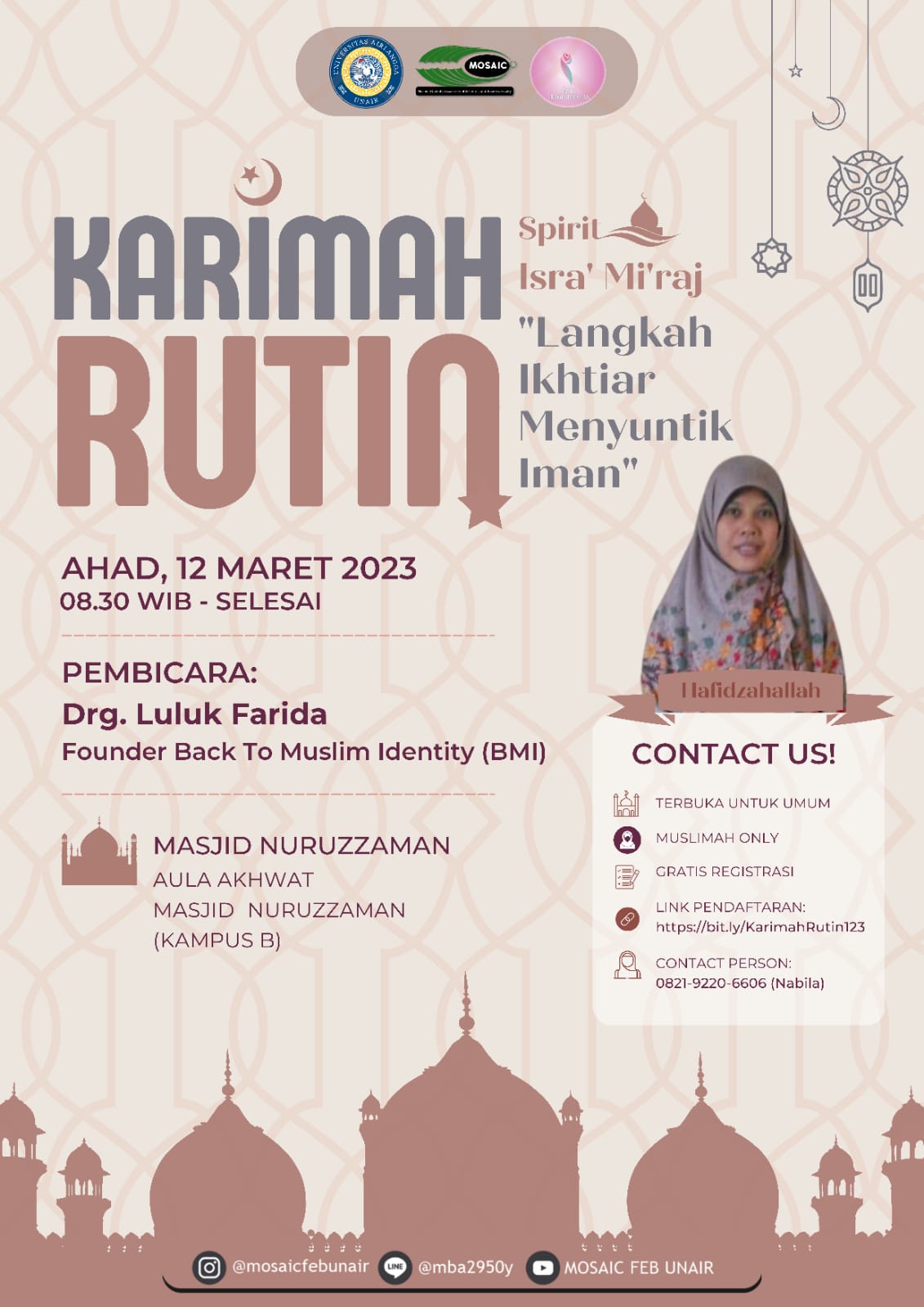
Routine Karimah is a series of Muslimah studies aimed at increasing brotherhood among Muslimah women and increasing insight regarding the ideal Muslimah by sharing studies about Muslimah with inspiring Muslimah speakers. This routine Karimah consists of material delivery sessions and discussions or questions and answers that will be filled by alumni, lecturers, or other Muslimah speakers. Routine Karimah was held on Sunday (Sunday), March 12, 2023. It was held offline at the Akhwat Hall of the Nuruzzaman Mosque, Campus B, Universitas Airlangga. The material discussed was "The Spirit of Isra' Mi'raj: Steps to Inject Faith" with speaker Drg. Luluk Farida —Founder of Back to Muslim Identity (BMI). Before participants take part in Routine Karimah, participants are required to fill out the registration via the provided Google Form and also join the WhatsApp Group so that participants do not miss out on the information explained.
The target audience for this routine Karimah activity is Muslim women in general, particularly students from the Faculty of Economics and Business, Universitas Airlangga. More than 25 Muslim women attended the event.
Through this routine Karimah activity, Mosaic's Muslim Division aims to highlight that women also have the right to access Islamic knowledge without limitations. This aligns with Sustainable Development Goals (SDGs) No. 4, "Quality Education," and No. 5, "Gender Equality.".
SDG No. 4 related to this activity is as follows:
- Access to Education: SDG No. 4 emphasizes the importance of providing access to quality education for all, regardless of gender or background. This means that Muslim women have an equal right to receive a quality Islamic education.
- Quality Education: SDG No. 4 highlights the importance of quality education. This means that Islamic studies attended by Muslim women must be high-quality and provide a deep understanding of their religion.
- Lifelong Education: The concept of lifelong education emphasized in SDG No. 4 is also relevant. This means that Muslim women have the right not only to receive Islamic education early in life, but also throughout their lives to deepen their knowledge and faith.
Meanwhile, SDG No. 5 is related to this activity, as follows:
- Equal Access: SDG No. 5 emphasizes the importance of gender equality, including equality in access to education. This means that Muslim women should have equal access to Islamic education as men.
- Women's Empowerment: Gender equality also encompasses women's empowerment, including in the context of education. Muslim women should be empowered to participate in Islamic studies and contribute to this field according to their potential.
- Elimination of Discrimination: SDG No. 5 also emphasizes the elimination of discrimination against women. This means that Muslim women should not be hindered or discriminated against in their efforts to increase their Islamic knowledge and faith through regular study.
SDGs 4 and 5 both support the right of Muslim women to undergo regular, quality Islamic studies. This not only strengthens Muslim women's knowledge and faith but also creates opportunities for empowerment and the elimination of discrimination against women in the context of religious education. Promoting access to and quality Islamic education for Muslim women is a step in line with the Sustainable Development Goals.