


This webinar, held by Dompet Dhuafa on October 7, 2021, focused on Hijrah and Waqf-Based Economic Revival. The event opened with remarks by Hendri Saparini, Treasurer of the Dompet Dhuafa Foundation, who briefly discussed the current economy and the potential of waqf.

The event continued with material from Prof. Dr. Raditya who discussed waqf-based economic migration. He explained that the scope of waqf is very broad, including infrastructure, food, education, energy, and health. If agricultural land and operational needs are met by waqf, then costs will be lower, thus benefiting farmers. He also explained the potential of waqf within the university area. According to him, it would be extraordinary if every university had a waqf institution whose funds could be managed for various needs such as infrastructure, scholarships, employee salaries, and others. He also explained the potential of waqf in the healthcare, energy, and crowdfunding sectors.

The next presentation was delivered by Dr. Ahmad Juwaini, who discussed optimizing waqf development to support national economic development. He began by explaining various waqf models around the world. Some are community-centered, others are handed over to local governments, others are centralized by a single organization, and some have been removed from state regulations but whose assets remain in those countries. He explained that waqf has both social and commercial dimensions. The social dimension is the distribution of waqf and the results of maukuf 'alaih (obligatory charity). However, waqf management is actually commercial.
He also explained issues regarding waqf management in Indonesia, including awareness, R&D and technology, regulations and institutions, and human resources. He then explained that much of the development of waqf in Indonesia remains inactive. Consequently, some waqf land is currently underutilized. According to him, creativity in waqf land use is needed. To foster this creativity, a waqf guarantor institution is needed as a supporting ecosystem. Furthermore, he explained that there are four issues to be addressed: literacy and education, nazir governance, digitalization, and management optimization.
The final speaker, Risyad Tri Setiaputra, explained Islamic fintech as a driver of the global Islamic economics. He began with the global Islamic economic index, which ranks Indonesia fourth, behind Malaysia, Saudi Arabia, and the UAE. He then discussed the potential of the Islamic fintech market in Indonesia, noting that it has a potential value of $2.9 billion. He also explained Indonesia's competitive advantage, noting that compared to Middle Eastern countries, Indonesia's GDP remains below that of other Middle Eastern countries. However, in terms of adoption of Islamic financial products, Indonesia outperforms Middle Eastern countries.
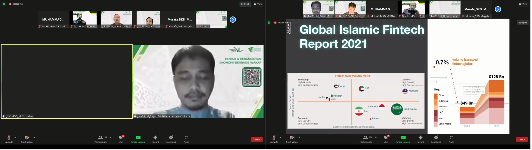
Malaysia's top ranking in the global Islamic finance index is explained. This is due to the strong contribution of the government and regulators. Meanwhile, Indonesia ranks in the top five due to its largest Muslim population and advanced Sharia fintech innovation. -mmr